Federation Assumes a Federation
A breakthrough proved the science works. The next chapter is making it sustainable.
The proof already exists
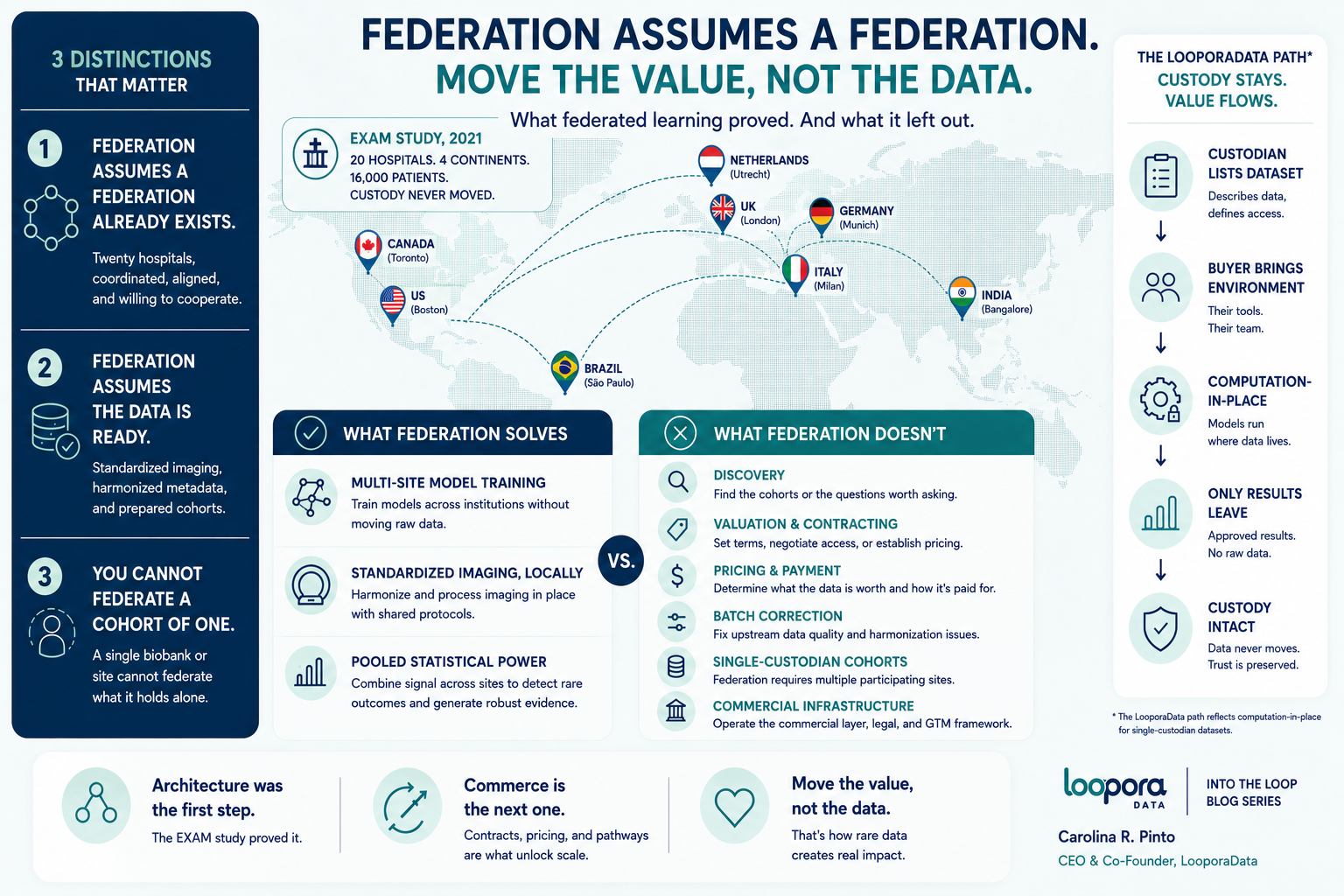
In 2021, Nature Medicine published a paper that should have changed everything. Twenty hospitals across four continents trained a single AI model to predict oxygen needs for COVID-19 patients. It outperformed every locally trained model. Small sites benefited most. And not one byte of patient data left any institution.
That is peer-reviewed, high-impact confirmation that analysis without custody transfer produces regulatory-grade results. The technique is called federated learning. The model travels to the data. Only what the model learned comes back.
The word does a lot of work
A federation is a group of parties who have already found each other, agreed to cooperate, negotiated terms, and cleared review. The technology solves the computing problem inside that agreement. Everything expensive happens before that point.
The EXAM study took five months from recruitment to first result. During a global emergency. With maximum institutional goodwill. Coordinated and funded by a chip manufacturer. Twenty separate IRB approvals. No custodian was paid.
Federated technology makes an existing collaboration cheaper. It does not create the collaboration.
For most healthcare data, the barrier is not computational. The custodian and buyer have never met. There is no price, no contract, no route from interest to access. The data is not merely locked away. It is commercially unreachable.
The compute problem is harder than it looks
Federation pools results across sites. For the math to work when you combine them, the data has to look enough alike at each site. Chest X-rays are tractable. The EXAM study worked because imaging is relatively standardized.
But the most valuable healthcare data is not imaging. It is omics: proteomics, metabolomics, genomics. And omics data breaks the federation model because of batch effects.
Batch effects are systematic technical differences between datasets that have nothing to do with biology. Different instruments. Different reagent lots. Different sample prep. The same biological sample processed on two mass spectrometers will look measurably different. Not because the biology changed. Because the machines are different.
Before you can analyze omics data, you have to normalize it, correct for batch effects, handle missing values, and align features. In a federated setting, you cannot see the raw data to do any of that. You are correcting for systematic technical differences across sites blind.
Federation assumes the data is ready. For the datasets that matter most, it almost never is.
You cannot federate a cohort of one
Federation scales with the number of participating sites. But the rarest and most valuable healthcare data sits with exactly one custodian. A single registry. A single biobank with matched tissue and plasma nobody else collected. You cannot federate a cohort that exists in one place. The question is whether that site is reachable at all.
Reachable, with custody intact
If analysis can travel to data for model training, it can travel for anything. That is computation-in-place. The buyer brings their full analytical environment. The dataset never leaves the custodian. Only approved results come back out.
For omics data this means the buyer runs their own normalization, their own batch correction, their own feature alignment. They are not locked into whatever preprocessing a federated protocol baked in. They see the data in context.
The layer that was missing
Architecture was the first step. The EXAM study proved it. But architecture without commerce produced twenty unpaid institutions and five months of coordination.
A custodian needs to know what their data is worth, who wants it, and how they get paid. A buyer needs to know what exists and what it costs. Neither is a computing problem.
LooporaData is the commercialization layer for rare healthcare datasets. Accessed in place, with governance that stays with the institution.
The science proved it. Five years on, it should not still take a pandemic and a benefactor to make it happen.
Move the value, not the data.